
Digital Product Passports: Transparency Through Dataspaces
Starting February 18, 2027, every industrial and electric vehicle battery with a capacity above 2 kWh sold in the European Union must have a Digital Product Passport (DPP). The EU Battery Regulation thereby creates one of the first mandatory use cases for dataspace-based transparency along the supply chain.
What Are Digital Product Passports?
A Digital Product Passport is a standardized, machine-readable data record that covers the entire lifecycle of a product. In the case of the Battery Regulation, this data record includes:
- Material composition and origin of raw materials
- Carbon footprint across the entire production process
- Capacity and performance data of the battery
- Recyclability and guidance for proper disposal
- Supply chain data including due diligence obligations
The EU Ecodesign for Sustainable Products Regulation (ESPR) mandates that DPP data must be provided in open, machine-readable formats such as JSON or XML to ensure interoperability.
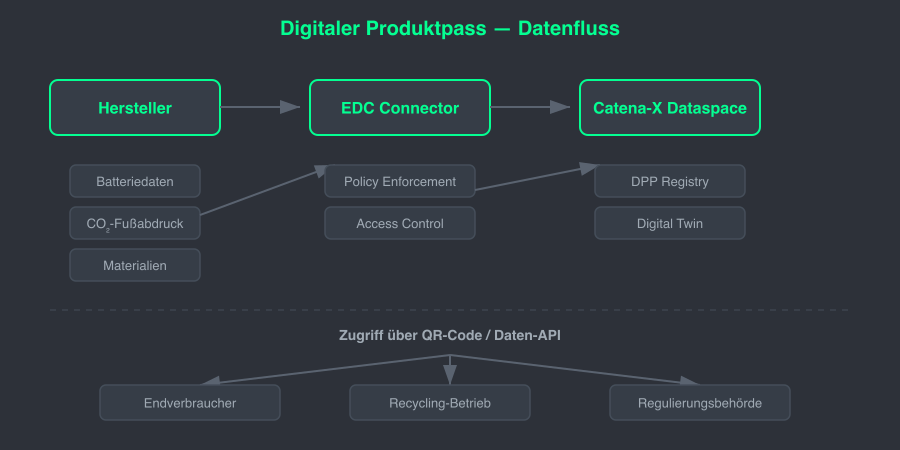
The following diagram shows the data flow of a Digital Product Passport:
Implementation Through Dataspaces
The technical implementation of Digital Product Passports is based on the Asset Administration Shell (AAS) and the accompanying Semantic Aspect Meta Models (SAMM). Catena-X provides an open, standardized infrastructure through which manufacturers, suppliers, and recycling companies can exchange data in a sovereign manner.
A simplified example of a battery passport data structure in JSON-LD format:
{
  "@context": {
    "catena-x": "https://w3id.org/catena-x/ontology#",
    "battery": "https://w3id.org/battery-passport#"
  },
  "@type": "battery:BatteryPassport",
  "battery:manufacturerIdentification": "BPNL00000003CRHK",
  "battery:batteryModel": "HV-Li-Ion-96S",
  "battery:ratedCapacity": {
    "@value": "72",
    "@type": "xsd:decimal",
    "battery:unit": "kWh"
  },
  "battery:carbonFootprint": {
    "battery:totalCO2": "3200 kg CO2-eq",
    "battery:calculationMethod": "EU 2023/1542 Annex II"
  },
  "battery:materialComposition": {
    "battery:lithium": "6.2%",
    "battery:cobalt": "8.1%",
    "battery:nickel": "32.5%"
  }
}
Why This Matters
Digital Product Passports are more than a regulatory obligation. They create end-to-end transparency from raw material extraction to recycling. Dataspaces like Catena-X ensure that this data is provided in a standardized, interoperable way while maintaining the data sovereignty of all participants. With the Battery Regulation as the first binding use case, the Digital Product Passport sets the pattern for further industries and product categories.