
Kubernetes Gateway API: Networking Reimagined
The classic Ingress resource has shaped Kubernetes networking for years. With the Gateway API, which reached GA status with version 1.0 (October 2023) and now stands at version 1.3, a significantly more powerful successor is available. At the same time, SIG Network has announced that Ingress-NGINX will move to best-effort maintenance starting March 2026.
What is the Gateway API?
The Gateway API is a collection of Kubernetes resources that provide a more expressive and extensible networking model. Unlike Ingress, the Gateway API natively supports:
- HTTP routing with header-based matching, path rewriting, and traffic splitting
- TLS termination and re-encryption at the gateway level
- Role-oriented design - Infrastructure teams manage Gateways, application teams define Routes
- Extensibility through standardized extension points instead of proprietary annotations
Version 1.3 (June 2025) introduced further capabilities including percentage-based request mirroring, CORS filters, Gateway merging, and retry budgets. The Ingress2Gateway tool (v1.0, March 2026) simplifies migration of existing Ingress resources.
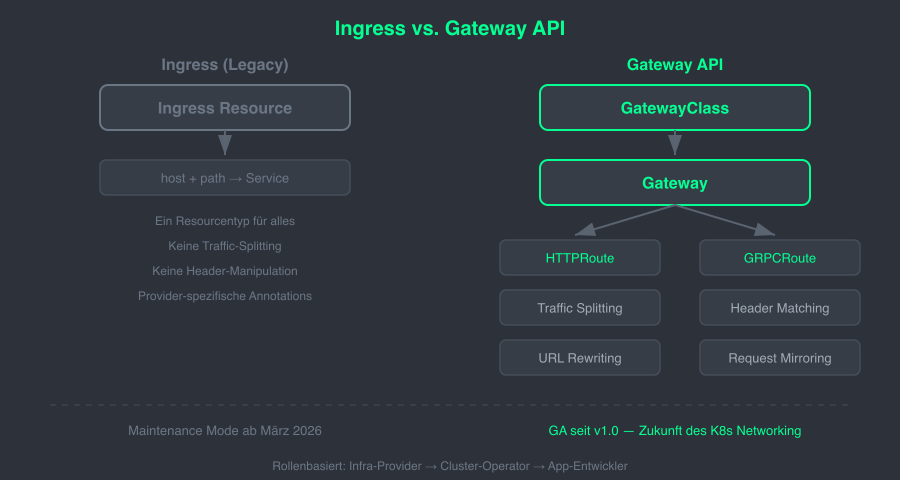
Differences from Ingress
A key difference lies in the separation of concerns. While Ingress bundles all configuration into a single resource, the Gateway API distributes responsibilities across three levels: GatewayClass, Gateway, and HTTPRoute.
A typical HTTPRoute definition:
apiVersion: gateway.networking.k8s.io/v1
kind: HTTPRoute
metadata:
  name: app-route
  namespace: production
spec:
  parentRefs:
    - name: main-gateway
  hostnames:
    - "app.example.com"
  rules:
    - matches:
        - path:
            type: PathPrefix
            value: /api
      backendRefs:
        - name: api-service
          port: 8080
          weight: 90
        - name: api-service-canary
          port: 8080
          weight: 10
This route directs traffic for /api to two backend services - 90 percent to the stable version, 10 percent to the canary version. Such traffic splits require external tools or controller-specific annotations with Ingress.
Why This Matters
With the phased retirement of Ingress-NGINX and growing support from implementations such as Istio, Envoy Gateway, NGINX Gateway Fabric, and the AWS Load Balancer Controller, the Gateway API is becoming the new standard for Kubernetes networking. The role-oriented architecture enables a clearer separation between platform and application teams - a decisive advantage in larger organizations.