Manufacturing-X: Dataspaces Beyond Automotive
With Catena-X, the automotive industry has demonstrated how sovereign data exchange between companies can work in practice. Now the German government is extending this principle to all manufacturing sectors: with Manufacturing-X.
What is Manufacturing-X?
Manufacturing-X is an initiative funded by the German Federal Ministry for Economic Affairs and Climate Action (BMWK) with a budget of approximately 152 million euros. The goal is to build a cross-sector, decentralized data ecosystem for Industry 4.0. Companies should be able to use data collaboratively across their manufacturing and supply chains -- while maintaining full data sovereignty.
Since 2024, initial funded projects have been running across various sectors:
- Factory-X for the machinery and equipment industry
- Aerospace-X for the aerospace industry
- Semiconductor-X for the semiconductor sector
- HealthTrack-X for the pharmaceutical industry
From Catena-X to Manufacturing-X
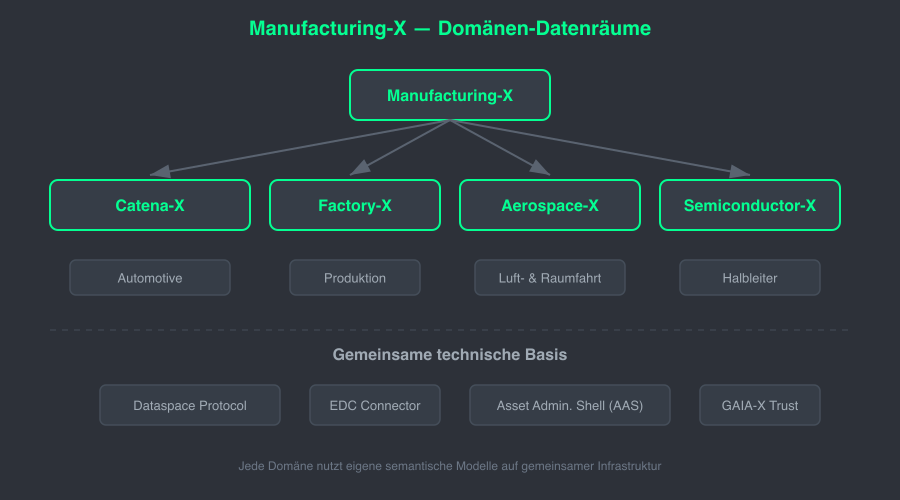
The technological foundation of Manufacturing-X is based on the same principles as Catena-X: Eclipse Dataspace Components (EDC), the Dataspace Protocol, and the Asset Administration Shell (AAS) as the standard format for digital twins.
The following diagram shows the overarching architecture of Manufacturing-X:
An example of an AAS submodel descriptor, as used across industries:
{
  "idShort": "TechnicalData",
  "id": "urn:example:submodel:technical-data:1.0",
  "semanticId": {
    "type": "ExternalReference",
    "keys": [
      {
        "type": "GlobalReference",
        "value": "urn:samm:io.catenax.technical_data:1.0.0"
      }
    ]
  },
  "endpoints": [
    {
      "interface": "SUBMODEL-3.0",
      "protocolInformation": {
        "href": "https://connector.example.com/api/submodel",
        "endpointProtocol": "HTTP",
        "endpointProtocolVersion": ["1.1"]
      }
    }
  ]
}
Why This Matters
Catena-X has proven that cross-company data exchange with clear rules and technical guarantees works. Manufacturing-X transfers these lessons to all of industry. This creates a unified digital infrastructure that enables innovation in areas such as predictive maintenance, supply chain transparency, and sustainable production -- independent of sector and fully scalable.